

Cold ablation
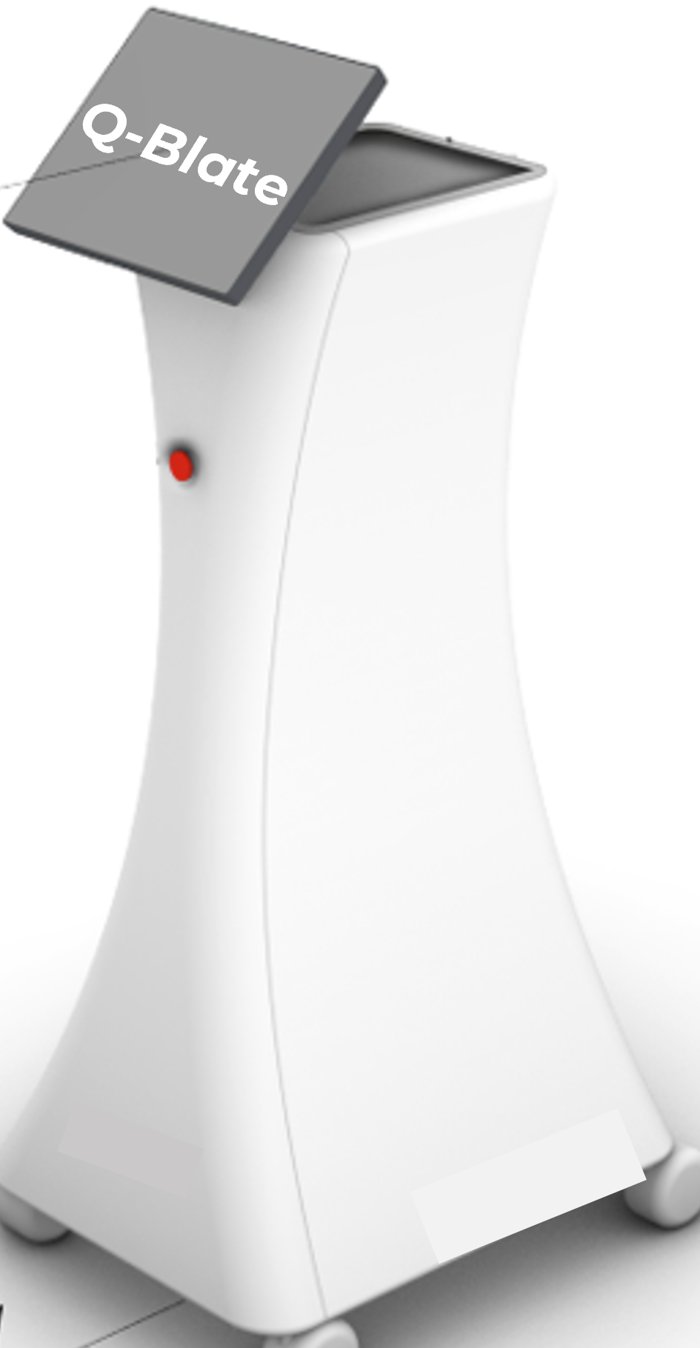
Q-Blate is the world's first cold ablation laser, aimed at delivering ablative treatment for all skin types and expanding applications well beyond scar elimination.
The problem
Fractional lasers work. Heat holds them back.
Fractional lasers treat rejuvenation, unwanted pigment, wrinkles, scars and laxity. The number of patients who choose them is limited by three factors, and all three trace back to excessive heating of the dermis.
Current technology needs numbing cream that can turn a 20-minute procedure into an 80-minute visit.
With no coagulation zones to heal, recovery is designed to be dramatically faster.
Removing the thermal injury removes the main trigger for post-inflammatory hyperpigmentation.
Mechanism of action
Only a narrow range of laser parameters produces cold ablation
Q-Blate pairs a mid-infrared wavelength strongly absorbed by water with picosecond-to-nanosecond pulses. The pulse ends before heat can travel out of the target volume.
Deposit
Laser energy is delivered into the skin through a fiber-coupled, ergonomic handpiece.
Confine
The energy is acoustically confined to the irradiated volume, so it cannot spread into surrounding tissue.
Eject
Tissue is ejected by the supersonic expansion of gaseous water, leaving no thermal damage behind.
Histological evidence
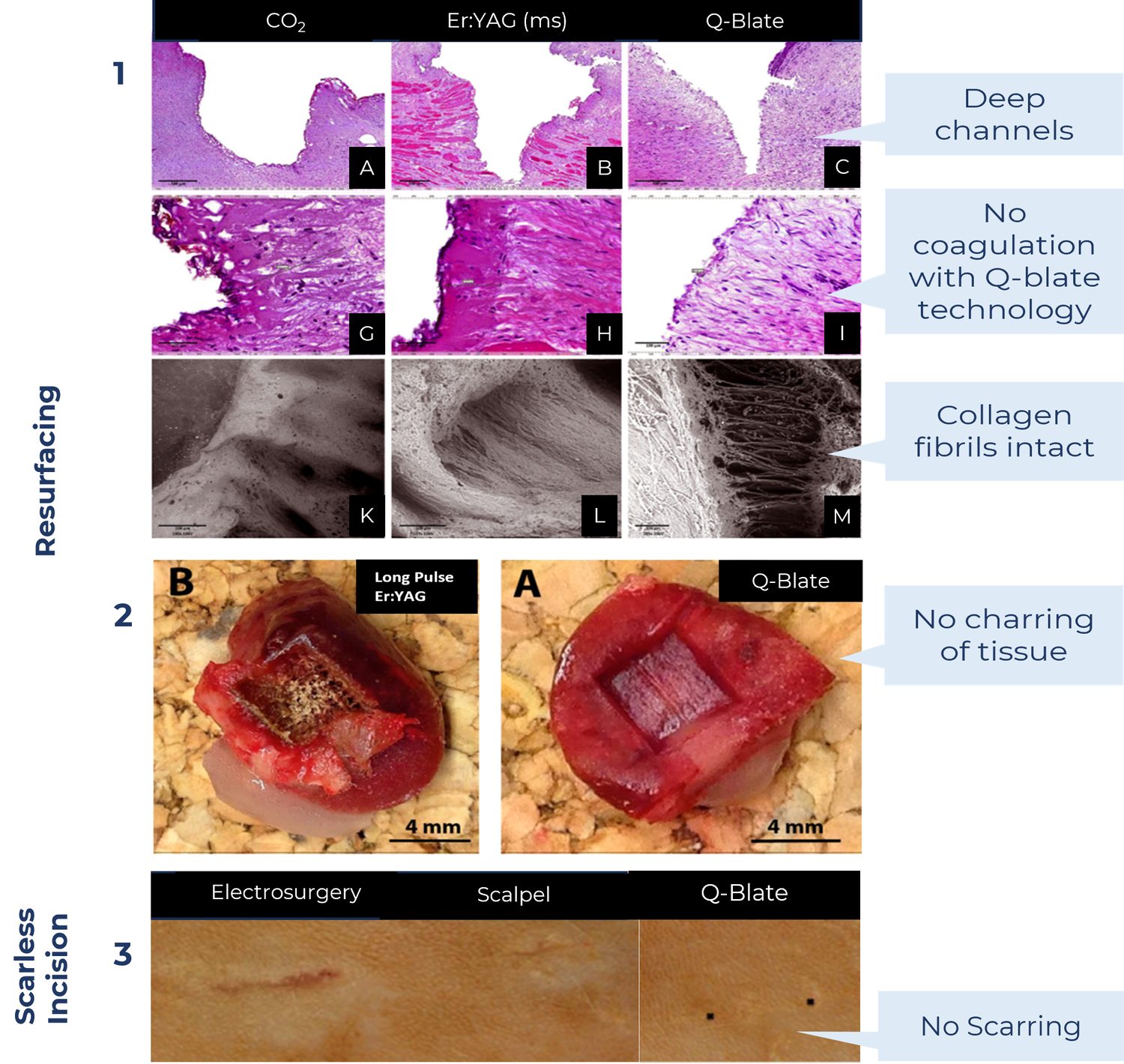
Deep channels with no coagulation
Published studies of picosecond infrared laser ablation show what removing heat from ablation looks like in tissue, compared with CO₂, Er:YAG, electrosurgery and the scalpel.
- Deep channels
- Best-in-class efficacy
- No coagulation
- Athermal, painless
- Intact periphery and collagen fibrils
- Minimal side effects, safe for all skin types, fast healing
- No charring
- No scar tissue, optimal for transdermal drug delivery
- No scarring
- Stretch mark and scar elimination
- Böttcher A, et al. Reduction of thermocoagulative injury via use of a picosecond infrared laser (PIRL) in laryngeal tissues. Eur Arch Otorhinolaryngol. 2015;272:941–948.
- Krutilin A, et al. Sampling of tissues with laser ablation for proteomics: comparison of picosecond infrared laser and microsecond infrared laser. J Proteome Res. 2019;18(3):1451–1457.
- Petersen H, et al. Comparative study of wound healing in rat skin following incision with a novel picosecond infrared laser (PIRL) and different surgical modalities. Lasers Surg Med. 2016;48(4):385–391.
Q-Blate
A no-compromise laser
A true cold ablation technology for skin resurfacing, rejuvenation and scar elimination.
- Painless
- Best-in-class efficacy
- Fast recovery
- Designed for all skin types
- Eliminates scars and stretch marks
- Improves transdermal drug delivery
Q-Blate is investigational. It has not been cleared or approved by the FDA and is not available for sale. Performance statements describe design goals.
Collaborate on cold ablation
We welcome conversations with clinical investigators, research institutions and strategic partners interested in Q-Blate.